News
GC Shares the Success of Its Fully Integrated Biorefinery, Reflecting Tangible Sustainability, creating Scalable Added Value by Transforming Used Cooking Oil into Bio-based Products
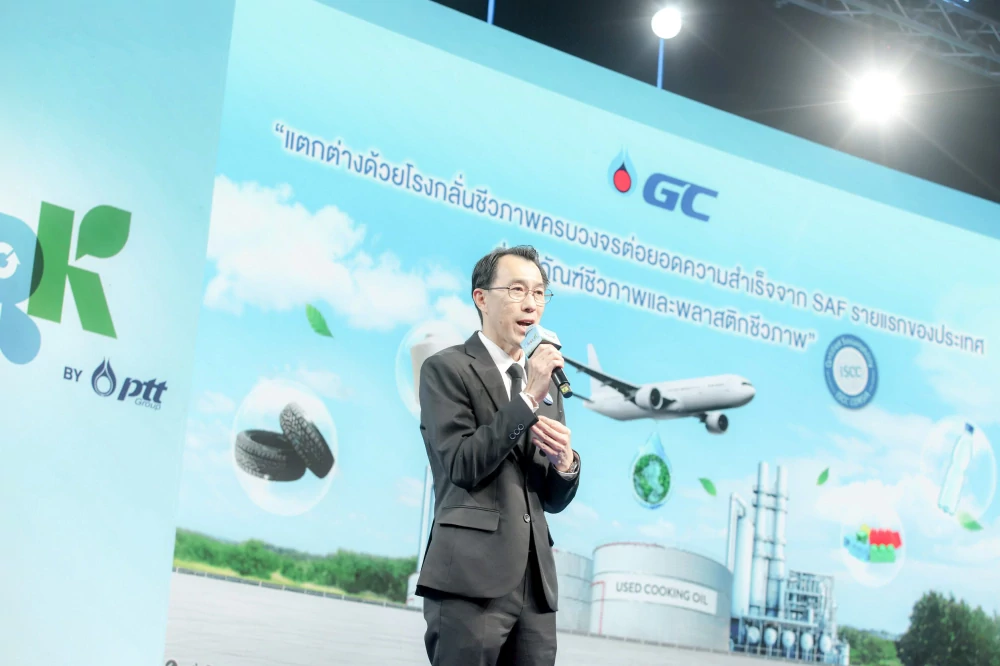
Bangkok – 27 January 2026 – Driving toward the Net Zero goal is not merely an environmental agenda, but a multifaceted industrial challenge that must be addressed in parallel across several dimensions—ranging from carbon reduction and economic viability to long-term scalability.
At Sustainability Spark by PTT Group 2026, PTT Global Chemical Public Company Limited, or GC, showcased the progress of its fully integrated biorefinery as a concrete example of turning sustainability into action. The initiative illustrates how sustainability can be translated into a value-creating, scalable business model at the industrial level by converting used cooking oil into Sustainable Aviation Fuel (SAF) and other high-value bio-based products.
GC is the first company in Thailand to pioneer the commercial production of Sustainable Aviation Fuel (SAF) through a biorefinery that uses co-processing technology to convert Used Cooking Oil (UCO) into clean energy and bio-based feedstocks. By upgrading and leveraging its existing refinery assets, GC maximizes operational efficiency while significantly reducing investment costs and development time compared with building a new facility. The process has been certified under the internationally recognized ISCC CORSIA sustainability standard, widely accepted across the global aviation industry, and can reduce carbon dioxide emissions by up to 85% compared with conventional jet fuel. This achievement reinforces GC’s high-value, low-carbon business strategy—one that is both commercially viable and practically achievable.
Biorefinery: A Bio-based Refinery Meeting Diverse Market Demands
Amid mounting pressure on the global aviation industry to reduce greenhouse gas emissions, GC leverages its industrial expertise to build a competitive advantage through its fully integrated biorefinery. The initiative begins with an initial Sustainable Aviation Fuel (SAF) production capacity of 6 million liters per year, with plans to scale up to 24 million liters annually in the future—contributing to an estimated reduction of approximately 60,000 tons of carbon emissions per year.
Beyond SAF, the biorefinery can produce more than 10 types of high-value bio-based chemicals and bioplastics. These include Bio-Propylene, a feedstock suitable for manufacturing children’s toys and automotive components; Bio-Butadiene, used in tire production; and Bio-PTA, a key raw material for producing PET plastics. These bio-based materials offer performance comparable to fossil-based alternatives, while delivering a significantly lower carbon footprint.
Mr. Phakkaphong Wangrattanasophon, Chief Operating Officer, Olefins and Intermediates Business Group, GC, stated, Used cooking oil, once regarded as waste, can be transformed into value and tangible benefits through GC’s biorefinery co-processing technology. It enables the production of Sustainable Aviation Fuel (SAF) and the further development into bio-based materials such as Bio-Circular Polypropylene (Bio-PP), which offers performance comparable to that of conventional plastics. Bio-PP can be used across a wide range of applications—from food trays and baby diapers to industrial products—and can be recycled in the future. This approach reflects that sustainability is not only about carbon reduction, but about maximizing resource efficiency, reducing dependence on petroleum-based feedstocks, and serving as a key mechanism in driving Thailand toward its Net Zero goal in a truly sustainable way.”
Meanwhile, Thailand—through the Department of Energy Business—has moved forward with the announcement of SAF standards and specifications, mandating the blending of Sustainable Aviation Fuel into jet fuel at a rate of 1% starting from 1 January 2026. This measure is designed to support the country’s low-carbon aviation pathway and its Net Zero ambitions.
In addition, the government has outlined a roadmap to gradually increase the SAF blending mandate, targeting a rise to 5–8% from 2033 onward. GC stands ready to support the nation’s SAF transition by developing solutions and collaborating with partners to help scale up production and accelerate real-world adoption—contributing tangibly to Thailand’s journey toward Net Zero.
Collaboration Across the Value Chain: Bio-based Plastics for Everyday Life
GC has also partnered with HMC Polymers Co., Ltd. to advance the Designed for Circularity concept, connecting the value chain from upstream to downstream. Under this collaboration, GC supplies bio-based feedstocks for the development of Bio-Circular Polypropylene (Bio-PP), produced using ISCC PLUS–certified technology with full traceability throughout the value chain.
Mr. Corso Uzielli, President of HMC Polymers, stated: “Sustainability does not begin with a single company—it starts with collaboration. HMC Polymers transforms bio-based feedstocks from GC into Bio-PP plastics, creating high-quality products found in our everyday lives, such as baby bottles, food trays, and toys. This approach helps reduce reliance on petroleum-based materials while enabling practical recyclability in daily use.”
“Sustainability does not begin with any single company—it starts with collaboration among all stakeholders. At HMC Polymers, we transform bio-based feedstocks from GC into Bio-Circular Polypropylene (Bio-PP), enabling the production of high-quality products used every day, such as baby bottles, food trays, and toys. This helps reduce reliance on petroleum-based materials while offering genuine recyclability in real-world applications.”
“Change does not always begin with something big. It can start with something as small as a single plastic pellet, or with simple actions such as collecting used cooking oil and feeding it back into the production process—so that together, we can truly create a cleaner world and cleaner air for future generations,” Mr. Corso added.
From Kitchen to Cockpit: Cross-Sector Partnerships Driving Sustainability
The “From Kitchen to Cockpit” collaboration project—part of GC’s biorefinery ecosystem—serves as another tangible example of building a circular economy ecosystem in practice. During the pilot phase from August to October 2025, GC and its network of partners in Rayong province collected a total of 7.09 tons of Used Cooking Oil (UCO), which was converted into 1.75 tons of Sustainable Aviation Fuel (SAF).
The initiative generated income for local communities and reduced greenhouse gas emissions by more than 5,654 kilograms of carbon dioxide equivalent (CO2e), highlighting the strong potential to scale up the project at a broader level.
GC has therefore expanded its collaboration with the Ministry of Higher Education, Science, Research, and Innovation (MHESI) to increase UCO collection points across higher education institutions nationwide. The initiative also aims to raise awareness among younger generations while supporting Thailand’s ambition to become an ASEAN low-carbon aviation hub.
Mr. Phakphong added: “To enable the transition at scale, GC initiated the ‘From Kitchen to Cockpit’ project by integrating collaboration across multiple sectors—from local communities in Rayong, educational institutions, and government agencies, to private-sector partners such as airlines. The initiative empowers the public to participate in collecting used cooking oil from households and feeding it into a low-carbon industrial system, which currently spans more than 40 locations nationwide.”
GC’s participation in the special panel discussion “From Kitchen to Creation: The Biorefinery Journey of Tomorrow” on the Spark Talk stage at Sustainability Spark by PTT Group 2026 underscores the company’s role as an organization that views sustainability not merely as a policy objective, but as a business growth engine—systematically connecting industry, communities, and the environment.
Other News