GC in Focus
EP. 8: SAF — The Turning Point for a Low-Carbon Sky
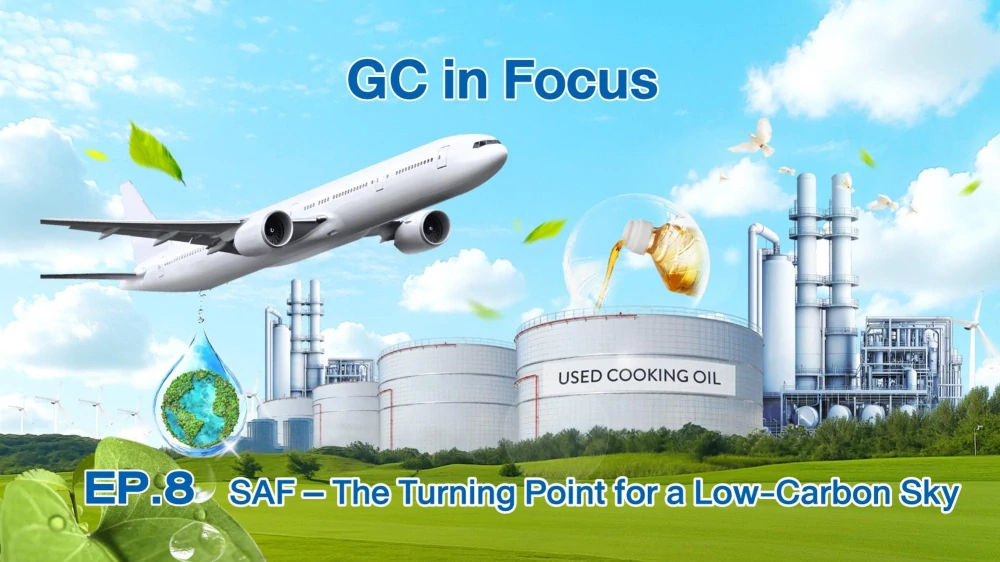
As the global aviation industry faces increasing environmental pressures, data from the International Civil Aviation Organization (ICAO) shows that in 2019 the sector emitted as much as 920 million tons of carbon, accounting for 2–2.5% of global CO₂ emissions.
Sustainable Aviation Fuel (SAF) has therefore emerged as a new beacon of hope for the aviation world — a critical alternative that can drive the industry’s transition toward true sustainability.
GC: Thailand’s First Mover in Sustainable Aviation Fuel
In early 2025, GC’s biorefinery announced a major milestone—becoming the first in Thailand to successfully produce Sustainable Aviation Fuel (SAF) from used cooking oil without the need to build a new facility. By leveraging our expertise and advancing existing knowledge, we optimized the process to integrate seamlessly with current refinery units. This approach not only reduced capital investment but also ensured that the SAF produced meets international certifications, including ISCC CORSIA and ISCC Plus.
This means that GC’s SAF delivers performance equivalent to conventional fossil-based jet fuel while generating a significantly lower carbon footprint. It can reduce greenhouse gas emissions by up to 80% compared to traditional aviation fuel—an achievement that strengthens Thailand’s aviation sector and propels it toward a clean energy economy.
GC: Powering Greener Flights for a Better Environment
GC-produced SAF has already been adopted in commercial flights operated by Bangkok Airways—marking a pivotal step toward developing an environmentally friendly aviation industry. This milestone helps position Thailand as a future low-carbon aviation hub in the ASEAN region, reinforcing GC’s strategy to expand its High Value & Low Carbon Business.
By enabling real-world decarbonization in aviation, GC continues to drive sustainable business growth while supporting a cleaner, greener future for all.
The Rising Future of SAF
SAF is gaining strong global momentum as the International Civil Aviation Organization (ICAO) targets net-zero greenhouse gas emissions for the aviation sector by 2050. In response, the global aviation industry is moving decisively toward adopting SAF.
GC is not only meeting the aviation sector’s growing demand for cleaner fuels but is also reinforcing its leadership in sustainable chemical innovations. The company continues to advance toward its Net Zero 2050 goal and plays a vital role in shaping a low-carbon sky—helping build a more sustainable future for everyone.
Other GC in Action